13 October 2026 · Translated from the Italian
Why Bother?
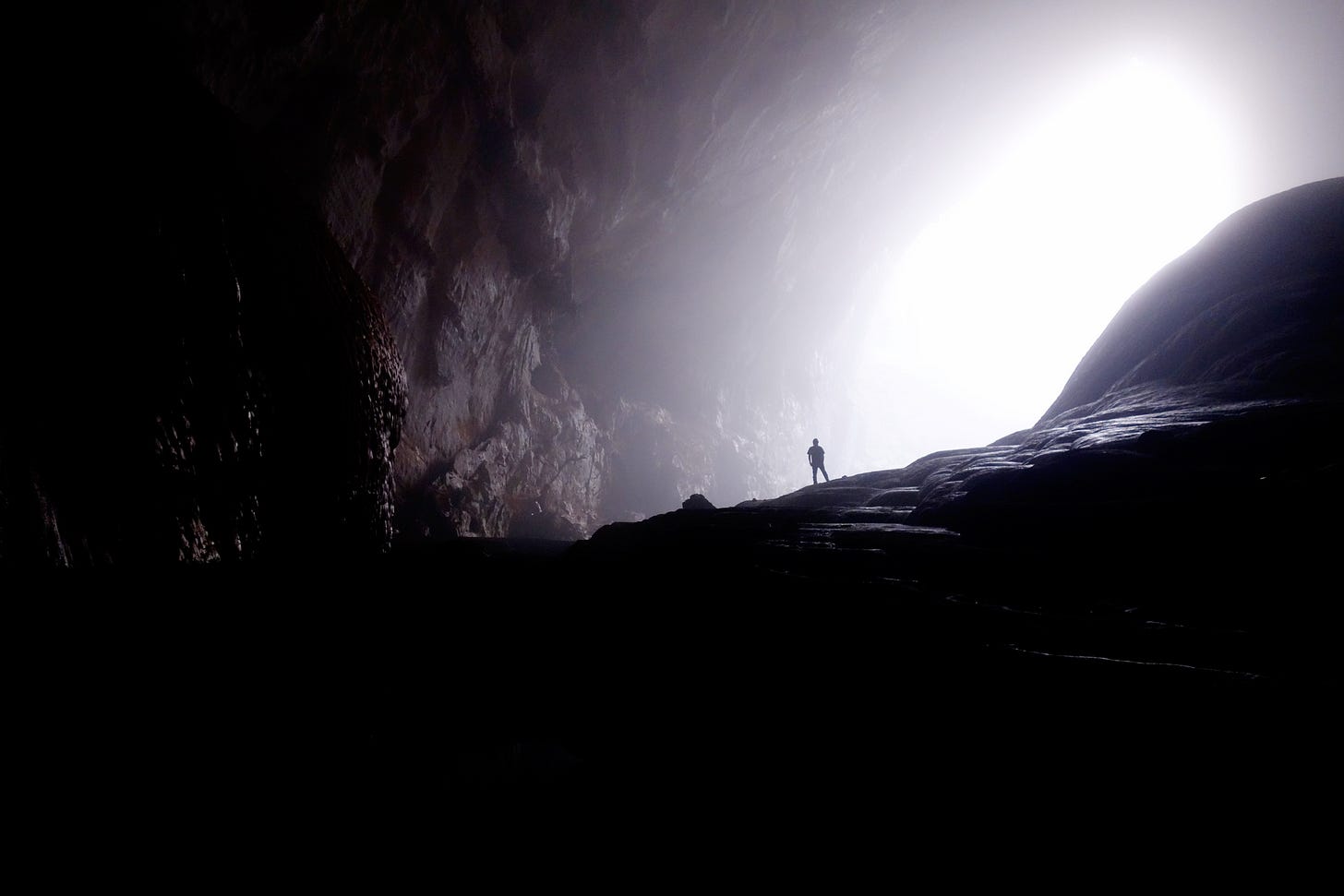
At two in the morning, five hundred metres beneath a mountain above Lake Iseo, a thirty-two-year-old woman puts her foot on a spot in the cave where no one has ever put a foot. It is 14 December 2024. Her name is Ottavia Piana, she has been a caver since she was a girl, and she is drawing a branch of the Abisso Bueno Fonteno for a map of what lies beneath the Sebino, a map that until her ended right there, at that passage. The passage gives way. The fall breaks her face, a knee, several vertebrae, several ribs. From that moment, for seventy-five hours, one hundred and fifty-nine people from the Soccorso Alpino, arriving from thirteen regions, take turns lowering themselves into tunnels you can only get through sideways, take the stretcher apart and put it back together at every squeeze, and bring her back up. She comes out at three in the morning on 18 December. It is the second time in a year and a half that the cave has held on to her.
Outside, in those same hours, the other thing happens. The country cheers her on for a day, then changes its tune. Who pays. Why did she even bother. The second time, no less. With our money. The president of the Società Speleologica says the same day that her own insurance is settling the bill, and the news lasts far less than the anger. While Ottavia is still in the dark with her face broken, someone on a phone is writing that she was asking for it. The hundred and fifty-nine who went down to fetch her are volunteers, and we never asked any of them why they bothered. We kept the question for her.
It is that question that interests me. Not the answer, the question. Why bother sounds like concern and is really a verdict, and like all verdicts it says more about the one who delivers it than about the one who receives it. Usually it comes from one of two people: the one who is afraid to try, and the one who is afraid you might actually pull it off. The first is easy to understand. The second is the one that concerns all of us, sooner or later. If the one who tries falls, the one who stayed at home was right to stay, and their fear, for a day, goes by the name of common sense. If instead the one who tries succeeds, they stay there, standing, reminding everyone that it could be done. That is why the question serves the one who asks it. We close ranks around those who stay, we jinx those who set out, and the failure of one becomes the absolution of everyone who stayed under cover. It is called negative solidarity, and it is the easiest kind of solidarity there is, because all it asks is that you stand still.
In 1912 a thirty-one-year-old German meteorologist, Alfred Wegener, stands in a hall in Frankfurt and says that the continents move. He says it looking at a map: the coast of Brazil and the coast of Africa fit together like the edges of a torn sheet of paper, and the same fossils turn up on both sides of the ocean. For the geologists of his day it is heresy, and from someone who is not even a geologist. They mock him for twenty years, and an idea that is now taught to eleven-year-olds passes, back then, for a delusion. He carries on doing what he did, which was going to see for himself. In November 1930, in Greenland, he leaves the station at the centre of the ice sheet, where he has just unloaded supplies, to head back to the coast with a companion and a sledge, at fifty degrees below zero. They find him in the spring, buried with care in the snow, inside his sleeping bag, with his skis planted upright to mark the spot. He was fifty. Thirty years later, when the ocean floors are finally mapped, the continents really do move, and the grandchildren of the people who laughed at him teach it at school under his name. He never had the satisfaction of knowing. But the question, why bother, they all asked him, and all of them from the wrong side.
In 1968 a twenty-one-year-old from Oregon, Dick Fosbury, turns up at the Mexico City Olympics with a way of jumping that makes people laugh. Everyone goes over the bar belly first, with the technique that has always been taught. He runs in on a curve, turns, and goes over on his back, head before feet, and lands on the back of his neck. A newspaper in his home town describes him as a fish flopping about in the bottom of a boat. Coaches tell him he will break his neck. His own coach, at high school, asks him to stop. He clears two metres twenty-four, wins gold with an Olympic record, and within ten years almost everyone in the world jumps the way he does. Even today, if you watch a high jump competition, you will see them all going over backwards, and nobody remembers any more that the move was once a thing for fish.
Wegener died on the ice, Fosbury died in his bed. One was proved right thirty years later, the other in an afternoon. But the words they heard from the people on the sidelines were exactly the same, and they came from the same place. When someone does something we do not have the courage to do, we have two roads. We can admit that it could be done, and then our life standing still becomes our own choice, with our signature at the bottom. Or we can decide that he is reckless, and then our life standing still becomes wisdom. The second road costs less. The brain, here, is honest to the point of embarrassment: when someone we envy stumbles, the same area lights up that lights up for food and for money. Nobody does it out of malice. We do it to feel less stupid.
This is where something comes from that we call prudence, and which is often fear that has found a presentable name. We have built a world that promises to be predictable, with the safe route, the insurance policy, the expert opinion, the seal of approval. I live inside it like everyone else. A promise like that only holds if every accident has a culprit: if you got hurt, it is because you left the track, and the track stays safe for everyone else. On Italian roads in 2024 three thousand and thirty people died, eight a day, and nobody started a debate about the bill, because that risk lies on the track, and on the track risk is invisible. A caver at the bottom of a cave is off it, and off the track every scratch is somebody’s fault. Blaming the ones who try costs little, because whoever is down there cannot answer back, and it pays well, because it saves us from asking what we are doing ourselves in the meantime.
I know because people ask me too, every time I leave for somewhere uncomfortable, with a family, at my age. I usually answer badly, because the real answer sounds pretentious over an aperitivo: I do it to see what it is like. Someone who goes down into a cave to map a branch nobody has seen is doing the same thing, with more mud. And I also know how the reckoning goes, in the end, because I have done it. Over weeks, we regret the things we did, the clumsy remark, the wrong choice. Over years, regret turns the other way round, and the things never tried are the ones that win. When a dear friend of mine died I wished for one thing only, to have spent more time with him, and the window had closed while I was looking elsewhere. What we call courage from the outside is, almost always, this reckoning done in advance: whoever sets out already knows there may not be a next time. Nobody, in the end, regrets a cave. What you regret is the time the cave was there, the curiosity was there, and you listened to the people saying why bother.
Ottavia Piana spent seventy-five hours in the dark, and for seventy-five hours someone, outside, argued about the bill. The bill, the one everyone was talking about, was covered. The branch she was mapping did not exist on paper before her. Now it does: five hundred metres beneath the mountain there is one more piece of the world, and we owe it to a woman who went down. Why bother? The answer was down there, and to see it you had to go down.
Mantica arrives every Tuesday, in Italian. Thousands of people read it, and it’s free.
Subscribe to ManticaMore letters →Stories →