14 August 2025 · Translated from the Italian
Nobody Is Special

What if I told you that you are not special?
That your life, your dreams and even your pain are more common than you think. Wouldn’t that be liberating?
Because perhaps true freedom is not being special, but no longer trying to be at all costs.
There comes a moment, sooner or later, when we realise that our story is not as unique as we believed.
It can happen in banal ways: a friend’s advice, a post on social media that seems to be speaking to us, a book we discover is not “ours alone” at all but shared by thousands of people.
Or in deeper ways, when a pain we thought was one of a kind is told by someone else, word for word, with an almost unsettling precision.
We live immersed in a culture that has convinced us that being special is a moral duty. From childhood we hear the same phrases over and over: “find your voice”, “follow your dream”, “stand out from the crowd”.
They are more than advice: they become silent commands, a compass that steers every choice we make.
So we move through the world as if we constantly had to prove we are worth more than average, as if our place in the world hung in the balance until we manage to stand out.
And yet the statistics are unforgiving: by definition, most of us are the average.
This is not a condemnation, and it does not mean we are without value. It means, rather, that we share far more than we like to admit. Our pain, our hopes, our fears are not so exceptional.
In this non-exceptionality lies something powerful: an invisible bond that unites us, like an underground thread running through everyone’s lives.
Leonard Cohen sang it in one of his best-loved lines:
“There is a crack in everything, that’s how the light gets in.”
At first, this realisation grates. It deflates an image of ourselves carefully built over the years.
But it is precisely there, in the crack in the ego, that fresh air can get in.
Because if we are not special, then we are free to be — simply — human.
And in that shared humanity, made of lives that intertwine and resemble one another, lies our greatest chance of connection.
The illusion of being special
That conviction, more or less conscious, of being different from others is not just a subjective impression: psychology has given it a precise name — illusory superiority (or the better-than-average effect).
It is the deep-rooted, widespread tendency to see ourselves as above average in positive qualities.
This is not a theoretical hypothesis. As early as 1981, the psychologist Ola Svenson showed, in an experiment destined to become famous, that 93% of American drivers and 69% of Swedish ones considered themselves “better than average” behind the wheel.
A statistically impossible result, but one that says a great deal about how our minds work. And it is not only about driving. We tend to overestimate our intelligence, our honesty, our sense of humour, even our capacity for empathy.
It is as if we lived with a slightly distorted lens, one that magnifies the traits we like and softens those we don’t want to see.
As a psychologist, I have always been struck by how powerful this mechanism is. In clinical practice I have seen people convinced they were exceptionally flawed or exceptionally right: two sides of the same illusion, both fed by a desperate need to feel unique.
The other side of the coin is impostor syndrome, first described in 1978 by Pauline Clance and Suzanne Imes.
Here the illusion is turned upside down: no longer the belief that we are better than average, but that we are a negative exception, unable to measure up.
The constant thought is: “Sooner or later they’ll find out I don’t deserve any of what I’ve achieved”.
The two conditions seem opposite, but in fact they share the same root: the idea of being a case apart.
In the first case, a rare talent; in the second, a unique failure.
Cognitive psychology offers several keys to understanding why these distortions are so common.
Alicke and Govorun’s self-enhancement theory shows that we tend to interpret information about ourselves in a self-serving way to protect our self-esteem.
Higgins’s self-discrepancy theory, on the other hand, explains that when we perceive too great a gap between our “actual self” and our “ideal self”, negative emotions such as shame, guilt and anxiety emerge.
On the neurobiological level, studies by Daniel Schacter and colleagues on the default mode network — the set of brain areas that become active when we are at rest and reflecting on ourselves — show that our mind is constantly engaged in a process of inner storytelling.
We select and distort memories to confirm the image we have of ourselves. We filter experiences, remember selectively, and interpret every episode as proof of our uniqueness, for better or for worse.
The result?
We live trapped behind a distorting lens: every common joy seems banal to us, every common pain seems exceptional.
And so normality — that web of shared experiences that makes us part of something larger — loses its dignity in our eyes.
And yet, right there — in that normality we consider uninteresting — lies an enormous potential, which writers like Susan Cain have managed to bring back to light.

Quiet — The power of not having to shine all the time
There is a line in Susan Cain’s Quiet that has stayed lodged in me like a splinter of light:
“Everyone shines, given the right lighting.”
And the right light, for some, is not the blinding glare of a spotlight.
It is the soft glow of a lamp on the table, the half-light of a quiet room, the silence of a library in the evening, the solitude of a walk in a park.
Yet we live in an age that pushes us all in the same direction: talk more, move more, put ourselves out there more.
Cain calls it the extrovert ideal: the idea that the only way to be recognised and appreciated is to be extroverted, sociable, always on stage.
It is a model that rewards speed, a quick tongue, the ability to capture attention — and that sees silence as an absence, reflection as a delay, discretion as a lack.
The result is that we live in a world designed for those who know how to shine in public, and we forget that not everyone is made for it.
More than that: we forget that there is nothing wrong with that.
Cain says it clearly: calm, listening, careful observation are not weaknesses but deep resources.
Those who move slowly, who prefer a deep conversation to a group one, who take time to think before acting, hold a rare gift: the ability to go deep in an age that lives on the surface.
Imagine a day when you don’t have to rush to tell everyone everything, don’t have to post every moment, don’t have to turn your own life into a show.
Imagine doing something just for the pleasure of doing it, without needing to show it.
That feeling of pressure easing, that breath growing longer, is the heart of what Cain calls self-acceptance: not the idea of “settling”, but the ability to recognise your own traits and use them as a strength, not an obstacle.
Accepting that we don’t all have to run at the same speed, speak at the same volume, display the same enthusiasm is a form of liberation.
Sometimes true freedom is not doing more, but no longer doing what is superfluous.
It is not adding, but taking away.
When we stop chasing the wrong light and start looking for the one that truly nourishes us, something simple and powerful happens: we stop reciting a script and start living our own part. That is where the idea of “normality” stops being a fallback and becomes an act of resistance.
The right to be normal (and even to get it wrong)
If our age had an unwritten commandment, it would sound like this:
You must get yourself noticed.
Show yourself. Tell your story. Share. Pile up experiences, stories, successes.
It doesn’t matter whether you feel ready or whether you have something true to say: what matters is being there, and letting it be seen.
Susan Cain calls it the cult of extroversion: a social model in which being competent is not enough, you have to be magnetic.
Having ideas is not enough, you have to know how to sell them with charisma.
Doing is not enough, you have to tell people you have done it — and with contagious enthusiasm.
But this rush for the stage comes at a high price, even when we don’t notice it straight away.
Curran and Hill’s research on perfectionism has shown that over the last thirty years the self-imposed pressure to be flawless has grown exponentially.
Along with it, anxiety, depression and burnout have risen, as if we were all trapped in a permanent marathon, never knowing where the finish line is.
I have often met people emptied out by this silent marathon, which leaves no room to stumble or to stop. The pressure “not to fall behind” keeps them constantly on edge, as if life were an exam that never ends.
The problem is that we live as if normality were a defect to be corrected.
As if days “without peaks” were wasted days.
As if a moment of tiredness, distraction or confusion were a fault to be erased as fast as possible.
And yet normality has always been the foundation of human life.
It has never been a “small thing” to be present, to be constant, to be faithful to a task or a relationship.
It is the silent weave that holds everything else together.
Cain puts it clearly in Quiet:
“If you like to do things in a slow and steady way, don’t let others make you feel as if you have to race.”
Claiming the right to be normal means this: freeing ourselves from the obligation to be exceptional.
Accepting that some days will leave no memorable trace.
That there will be moments when we feel bored, confused, imperfect — and that there will be no need to turn them into a self-improvement project.
In fact, it is precisely in lives lived away from the clamour that one of the purest forms of freedom is found: not having to play a part all the time.
Being able to be “just” a person — with a job, a home, a circle of loved ones, a rhythm of one’s own.
It isn’t resignation, it is a choice.
And in a world that always wants us at full speed and on display, it is also a form of quiet rebellion.
The miracle in the ordinary
There is a strange, almost unexpected peace in realising that we don’t have to be extraordinary to live well.
It is like taking off a rucksack after a long walk: at first you stay bent over, used to the weight, then slowly you straighten up and notice you are breathing better.
When we stop chasing the idea of distinction, our perspective changes.
We start to notice the quiet rhythm that holds the days together:
the neighbour who waters the plants even when no one is watching;
the colleague who brings you a coffee for no reason;
the ray of sunlight filtering through the curtains at eight in the morning, punctual as a silent greeting.
Normality, when you look at it closely, is not grey.
It is a mosaic of small lights.
They don’t explode, they don’t dazzle, but they shine steadily.
And perhaps this is a greater power than any showy success: to last, to support, to accompany.
Claiming the right to be normal also means saying to the world:
I can live well without your applause.
I can allow myself to get things wrong, to stop, even to be bored — without feeling any less worthy for it.
Susan Cain reminds us that “everyone shines, given the right lighting”.
Perhaps our right light is not the glare of the stage, but the more discreet light of a candle on the table.
And as with a candle, its flame can last a long time, warm those close to us and be enough for ourselves.
So the miracle of the ordinary is not a rare event.
It is as if every life were a knot in an endless weave: we hold each other up without knowing it, leaving invisible footprints that become foundations for those who come after.
This is one more reason why I have always been obsessed with lives gone by.
They have always intrigued me, almost morbidly.
A few years ago I started building my family tree, trying to piece together the story of those who came before me.
So far I have traced 113 people, almost six generations.
It is a staggering number.
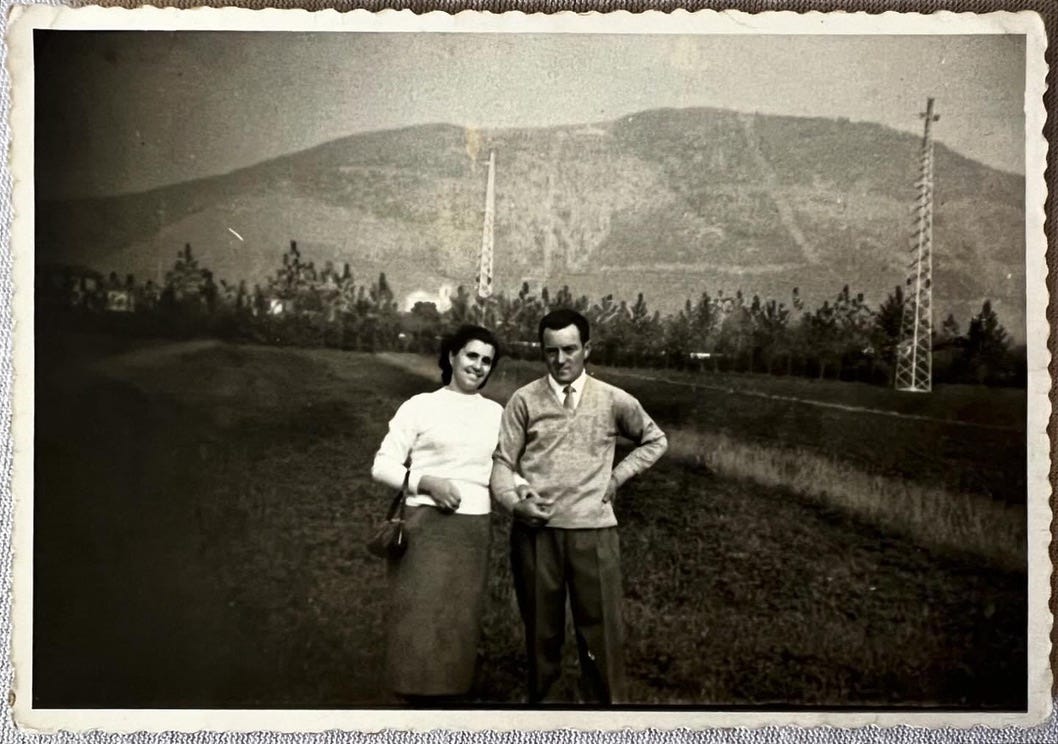
A few weeks ago, thanks to my father, a photograph of my grandparents came into my hands: Paolo and Giulia.
It is just after the war; they must be a little over thirty.
I study their expressions closely, as I put them in their place in the story.
Suddenly the tree comes alive.
All 113 people in this drawing stir into life.
A huge lump rises in my throat as, looking at them, I wonder how many times they thought of giving up, or what they had to face.
I wonder what truly made them happy, or whether they ever wanted to be, because perhaps it was enough for them just to be content.
I know nothing about them.
In the same way, I wonder what people will say in the future, looking at my photo.
How many details will be remembered? One word, perhaps two.
Maybe not even those, and that is perfectly normal.
I will be one photo among many.
All the rest of my life will vanish into the sea of time.
Nothing is eternal, just as nothing is truly important.
We live crushed into an eternal present, but it is the bigger picture that makes the difference.
Not the single episode, not even the single life.
It is the trajectory that counts.
And yet I am certain there must be some kind of thread running through us all, a kind of interweaving.
We are always alone with our fears, each with our own worries.
When we realise that we are neither the first nor the last to feel these emotions, because they are part of a larger chain, everything looks different.
These photos seem to say:
“Hey, you know, it happened to me too.”
Then you understand that you are not the first, you are not the last.
They are there too, just as overwhelmed by fears, passions, turmoil.
Each of our lives is a novel.
We are all prisoners of an invisible web of which we are also the makers.
If we learned to understand and to see these repetitions and coincidences, each of our lives would become clearer, more attuned to what we are and to what we ought to be.
Deep down, we are less free than we think.
Then my father adds something about the photo:
“That one behind them is Monte Orfano, and until then there wasn’t a single tree on it. Then they planted the whole thing, and today it’s the wood you see.”
What is dead can come back to life.
What an extraordinary message for the future.
Perhaps this is the very heart of freedom: not chasing glory, but leaving quiet traces that keep growing, just like a wood. And accepting that, in the end, we don’t have to be special to have a profound impact.
If this has helped you breathe a little more lightly, pass it on to others.
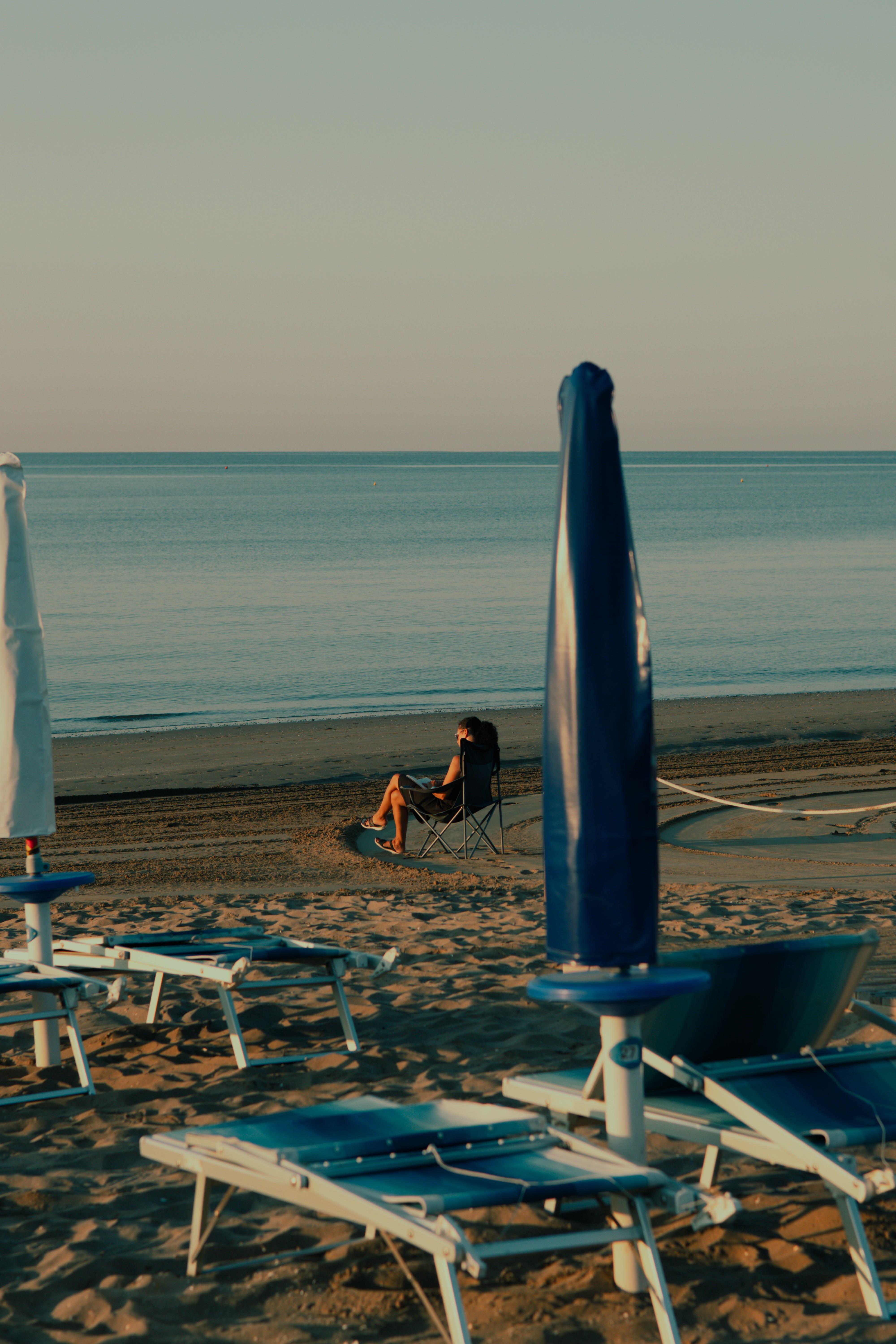
All the photos in this article are mine, taken the other day during a perfectly ordinary – and not at all special – sunrise on an Italian beach.

Deep dive 1 — Illusory superiority: the mind’s trick that makes us believe we are special
The better-than-average effect is one of the most studied cognitive biases.
It works like this: when we compare ourselves with a statistical average, we tend to place ourselves above it on the qualities we consider desirable (intelligence, empathy, driving skill), and below it on the undesirable ones (selfishness, aggressiveness).
This happens because:
We have no direct access to other people’s minds, so we rely on stereotypes.
We judge ourselves at our best moments and others at their worst.
We have a psychological need to keep our self-esteem high.
The result: statistically, it is impossible for “almost everyone” to be above average… but emotionally, it is reassuring.
Deep dive 2 — Quiet and the “extrovert ideal”
In her book Quiet, Susan Cain gave the name extrovert ideal to the deep-rooted belief that the model of a successful person is extroverted, brilliant in public, energetic in relationships.
This model has shaped schools, companies and even the way we structure our free time.
Cain’s research shows, however, that:
Introverts are no less capable: they simply work better in low-stimulation settings.
Creativity and innovation are often born of solitude and reflection.
Forcing a person to play a social role at odds with their temperament can lead to chronic stress.
The right to normality, from this perspective, also becomes the right to choose one’s own rhythm and one’s own light.
Sources and research cited
Svenson, O. (1981) – Are we all less risky and more skillful than our fellow drivers? Acta Psychologica, 47(2), 143–148.
Clance, P.R., & Imes, S.A. (1978) – The Impostor Phenomenon in High Achieving Women: Dynamics and Therapeutic Intervention. Psychotherapy: Theory, Research & Practice, 15(3), 241–247.
Alicke, M.D., & Govorun, O. (2005) – The Better-Than-Average Effect. In M.D. Alicke et al. (Eds.), The Self in Social Judgment. New York: Psychology Press.
Higgins, E.T. (1987) – Self-Discrepancy: A Theory Relating Self and Affect. Psychological Review, 94(3), 319–340.
Schacter, D.L. et al. (2007) – Remembering the Past to Imagine the Future: The Prospective Brain. Nature Reviews Neuroscience, 8(9), 657–661.
Curran, T., & Hill, A.P. (2019) – Perfectionism Is Increasing Over Time: A Meta-Analysis of Birth Cohort Differences From 1989 to 2016. Psychological Bulletin, 145(4), 410–429.
Cain, S. (2012) – Quiet: The Power of Introverts in a World That Can't Stop Talking. New York: Crown Publishing Group.
Mantica arrives every Tuesday, in Italian. Thousands of people read it, and it’s free.
Subscribe to ManticaMore letters →Stories →