15 September 2026 · Translated from the Italian
At a Distance
A few weeks ago a dear friend was talking about when he was young and you would sometimes end up arguing in a bar, and now and then come to blows. Then you would pick yourselves up, look at each other, and often end up having a beer together. The fight ended there. It was settled. He said it with no nostalgia for the punches, only for the beer afterwards. I understood why a few days later, thinking back to something I had read years ago about weapons.

In 1139 the Second Lateran Council, in canon twenty-nine, forbids the use of the bow and the crossbow against Christians. Ferocity has little to do with it: the sword killed perfectly well. The crossbow is called a deadly art, hateful to God, because it kills without looking you in the face. With the sword, the enemy saw you. Sometimes he spoke to you. He could ask for mercy, and you could grant it. At a distance he becomes a target, and a target keeps quiet. Four centuries later Ariosto curses the arquebus in the Furioso, “O cursed, O abominable device”, forged in hell, and adds that because of it the profession of arms has lost its honour, and the coward looks better than the brave. The knight Bayard, the one without fear and without reproach, had captured arquebusiers hanged, so tradition says, because killing from afar seemed to him an infamy. In 1524 an arquebus killed him. A story that writes its own ending.
They had understood something that science would measure four hundred years later: the brake that stops us doing harm lies in the other person’s face. Konrad Lorenz observed that wolves have an inhibition against the final blow, and it kicks in when the loser offers his throat. It is a contact mechanism. It only works if you see the gesture. Someone pressing a button is shielded from it, and kills what he would spare with his bare hands. Dave Grossman, who spent his life studying how a man is brought to kill, drew the scale: resistance is highest when you use your hands or a knife, and drops with every metre, down to almost zero for those dropping bombs from a plane. And trauma follows the same scale: those who have killed up close live with it for ever, those who have killed from afar sleep. Milgram proved it in the laboratory in one of the most famous experiments in the history of psychology: when the victim of the shocks was in another room, sixty-five per cent obeyed; when you had to hold the victim’s hand down on the plate, thirty. Thirty-five points of humanity, all of them within an arm’s length.
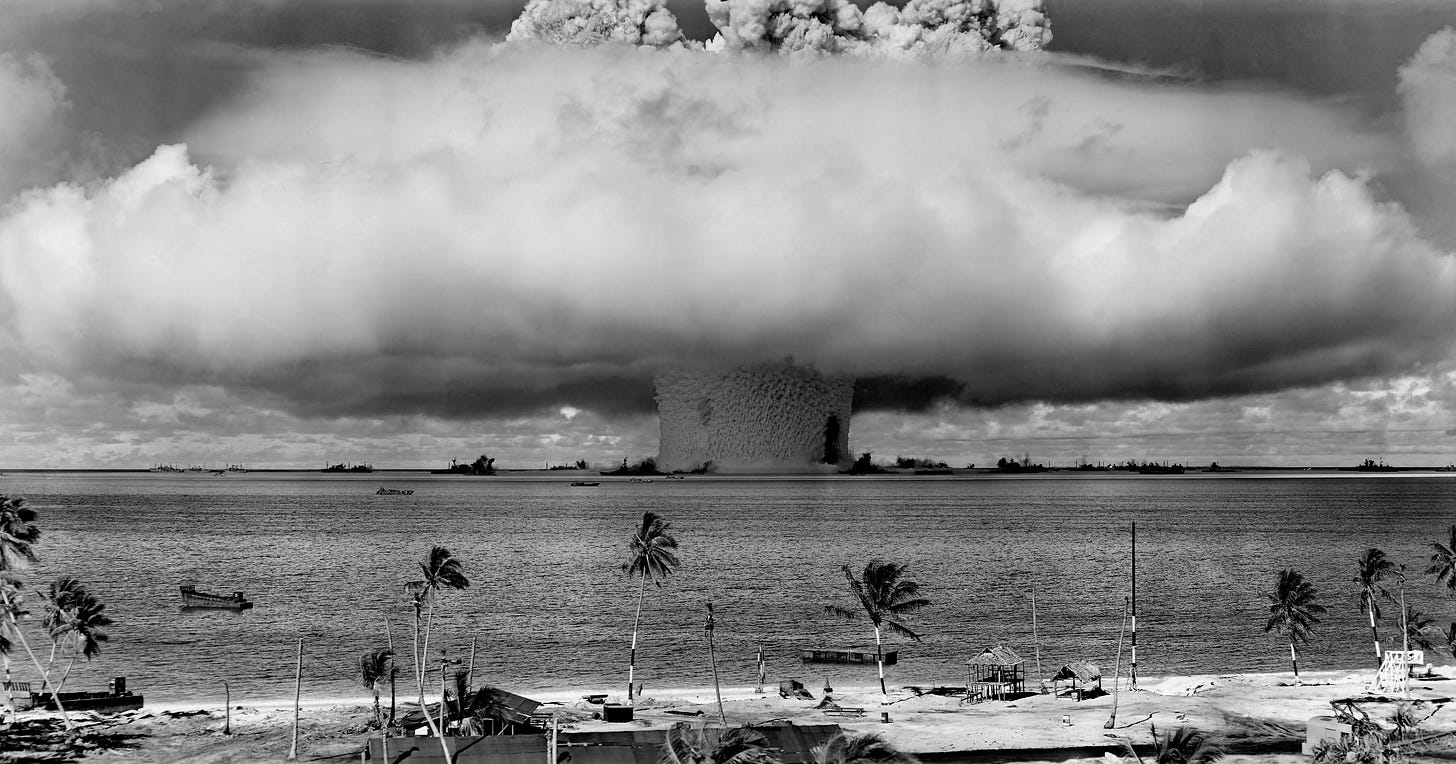
At the top of the scale is the atomic bomb, the weapon that kills without seeing anyone, and its legal history is the final proof. Michele Serra, in a monologue, pointed out that fifty atomic bombs are enough to wipe out humanity and we have fifteen thousand, a waste that not even the logic of war can explain. Chemical weapons, biological weapons, landmines, cluster bombs are banned under international law. The atomic bomb is not. In 2016 the UN voted to begin the process of banning it: thirty-eight countries against, the nine that possess it and their allies, Italy included, which keeps some seventy of them on its bases. Canon twenty-nine had forbidden the first blind weapon. Eight hundred years later, the blindest weapon of all is the only one its holders refuse to ban. The further away the face, the less the conscience asks.
I have always thought these experiments say something simpler than the version usually told. Our goodness is a matter of centimetres. We think we are moral people, and we are people with good eyesight.
Then we invented the ultimate crossbow, and put it in everyone’s pocket.
In 2004 a psychologist, John Suler, gave a name to what anyone had already seen on forums: the online disinhibition effect. It is characterised by six factors, and the first two are more than enough: anonymity and invisibility. The second applies even under your full name, because what is missing is the face, and without a face empathy drops, exactly as in Milgram’s room. A comment is a crossbow bolt: it leaves, it lands, and whoever loosed it has already turned the page. Forty-seven per cent of Italian teenagers aged fifteen to nineteen have suffered cyberbullying, Save the Children said in February; in 2020 it was thirty-four. And behind the number there is a scene everyone has witnessed at least once. Someone writes at midnight that you are an idiot, in capitals, with three exclamation marks. Then he meets you, at a book launch, in a bar, and asks you for a photo. Same person, same thumb. What changed was the distance, and the distance was everything.

I think about it often as a clinician, because the bullying I hear described today has a new shape. Once the bully had to look his victim in the face, and the face, sooner or later, presented the bill: tears, shame, an adult walking by. Not any more. The boy who writes the worst thing writes it in the dark, and the worst thing arrives in a bedroom, at night, with nobody walking by. This is the root of digital bullying: the same root as canon twenty-nine. A deadly art because it does not look.
But it was not the kids who invented distance. They inherited it from us, and we use it with elegance. In 2021 the chief executive of an American company fired nine hundred people on a three-minute video call, with only his own camera switched on. In 2023 twelve thousand employees of one of the richest companies in the world learned they were out from an email that arrived at dawn, before they had even got to the office; some found out because their badge had stopped opening the door. Picture the scene from the other side: coffee in hand, the usual parking space, and a door that answers with a different sound. Years of work announced by a lock. Whoever signed those decisions was able to do it without looking at a face, and that is the only reason they were taken that way. And this is also how the slow version works, the one anyone who has worked in a company knows: the person they want rid of, who little by little stops being invited to meetings, who finds their desk moved, their project taken away, the hellos shorter. Nobody fires them. They are pushed further away until they are a name in a spreadsheet, and names in spreadsheets get deleted without inhibition, because the throat they offer stays off the screen. Depersonalising is the first act of all violence, and the last to be called by its name. First you remove the face, then you do what the face would have prevented.
And here my friend comes back, with his beer.
Frans de Waal spent forty years watching chimpanzees, and discovered that after a scuffle the two opponents seek each other out, embrace, kiss on the mouth. He called it reconciliation, and showed that it happens only through contact: without closeness, the conflict stays open. That was what was precious about the bar fight: an afterwards. You got back up, you looked at each other, and the other man’s face, swollen, said it was over. Distance removes the brake before the blow, and they already knew that in 1139. But it also removes the closure afterwards, and that one is ours. Online the fight never ends. No counter to lean on, no beer, no split lip to make you ashamed enough to pay for the round yourself. Only the bolt, and the silence.
Lévinas wrote that the face of the other is the first law, before any law: it looks at us and says do not kill. Every weapon in history has been a way of taking that face out of the sights, and the latest, the one we all have in our pockets, has succeeded completely.
My friend said it without knowing it: he could not have cared less about the punches, it was the beer afterwards he missed. Because the beer was proof that the other man had a face, and that you had looked at it. Everything we keep at a distance, a comment, a dismissal, a colleague who has vanished from the meetings, begins exactly where that gaze ends. Going back to fist fights is no use. What we need is to stay close enough that we have to buy the beer.
Mantica arrives every Tuesday, in Italian. Thousands of people read it, and it’s free.
Subscribe to ManticaMore letters →Stories →