3 November 2026 · Translated from the Italian
A Thousand Copies
When Umberto Eco finished writing his first novel, in 1980, he was thinking of giving it to Franco Maria Ricci, the art-book publisher, for a print run of a thousand copies in a refined series. A thousand. An object for the few, by the few, to be placed in the hands of whoever had the patience to read a mystery set in a fourteenth-century monastery, full of Latin, of monks, of theological disputes about the poverty of Christ. Eco was nearly fifty, taught at the university, and was already a respected name in semiotics. A serious intellectual, allowing himself, almost as a game, a detour into fiction. And expecting from that detour, at most, a niche.
The book was The Name of the Rose. Bompiani printed ten thousand, and reprinted it twice within a few months, because something was already happening that nobody had foreseen, the author included. It won the Strega Prize the following year. Then began a run that stopped only with Eco’s death: translated into more than forty languages, fifty million copies worldwide according to the estimates in circulation, one of the best-selling books in history. A dense novel, full of references most readers barely caught, ended up in the homes of half the planet. And the man who had written it, at the start, was thinking of printing a thousand.
On the numbers, Eco was wrong. On the reason, he was right, and that is where the story stops being an anecdote.
In the Postscript he wrote three years later, to explain why a professor of semiotics had set about writing a medieval mystery, he said that he felt like poisoning a monk. That was all. No audience in mind, no market, no idea of what people wanted to read in those years. A precise and slightly ridiculous desire, and behind that desire a whole life spent on medieval texts, on semiotics, on the workings of signs and stories, which at a certain point asked to come out in another form. He wrote the book he would have wanted to read himself, for those who would smile at the Latin, for those who would recognise a theological dispute, for those who would catch one reference in ten and enjoy themselves anyway. The thousand he imagined resembled him. He took something difficult and made it gripping, leaving it difficult, because that was how he liked it.
The rest of the world came later, and for a reason that still holds. A thing made for everyone is a thing without edges, and things without edges slip away: we understand them at once and forget them straight after, because memory hooks on to what resists it. Byung-Chul Han calls it the culture of complaisance: what has to please before it exists learns to sand itself down, and the like works as an analgesic, taking away the discomfort and, with the discomfort, the chance that something might touch us. A thing made for yourself, on the other hand, carries a density inside it that you can feel even when you cannot decipher it. The readers who passed The Name of the Rose from hand to hand caught one reference in ten, and passed it on all the same, because people gladly give away what cost its maker effort. Making a thing for yourself, and making it all the way, is the only way I know to reach other people. Making it for others is the surest way to reach nobody in particular.
Eco knew this so well that he defended it against everyone. The first hundred pages of The Name of the Rose are hard going: descriptions, theology, an abbey to be learnt by heart before anything happens. His friends told him to cut them, and some at the publishing house thought so too. He refused, and in the Postscript he explained why: those hundred pages were a penance, an initiation, and whoever wanted to enter the abbey had to accept its rhythm. Whoever could not manage it would stay at the foot of the hill, and so be it. A man who thinks of an audience cuts the hundred pages. A man who thinks of the book leaves them, because the book is made of those too, and the readers who have crossed them remember them the way you remember a climb. Me first of all.
And it holds outside books exactly as it does inside them. The village osteria that has cooked a single dish for thirty years, because it is what the cook knows how to make and likes making, has a queue out of the door on Saturday night; the place with a menu that pleases everyone changes hands every two years. The single dish is an edge. People go back for that, and tell others about it.
Time is the part of this story I like best. Eco writes his first novel at nearly fifty, after a whole life spent doing something else: a professor who gets there late, by side roads, bringing with him everything he had learnt doing another job. Seen from outside, he was late. Seen from inside, he was perfectly on time, because he could not have written that book at thirty: he was missing twenty years of monks. The delay was the time it took, and the clock was his. For the things you do for yourself the right moment does not exist, because nobody sets it from outside. At twenty-five Eco would have written another book, nimbler and emptier. At sixty perhaps none at all. The Name of the Rose could only have been born in that very year, from that very man, with those twenty years of monks on his shoulders.
I know this business of time up close, though from the reader’s side rather than the writer’s. I first read The Name of the Rose at fifteen, because you had to. I slid over it, got lost among the monks and the Latin and the disputes, and finished it out of duty, and it left me almost nothing. But that was me at fifteen: still outside the thousand. Years later, by then a devourer of alchemy and esotericism, I came across Foucault’s Pendulum, Eco’s second novel, and was thunderstruck. Only then, coming in through a side door all my own, did I go back to The Name of the Rose and really read it, properly. The same book. A different reader. In between, the years both of them needed. On the other side, the writer’s, I got there late too: my first book past forty, and a job left at forty-three to do this. Every now and then I do the sums and it seems I started after everyone else. Then I think of Eco’s monks, and the sums add up: what I did before is the only reason I can do this now. There has not been a better moment to begin, and in all likelihood there will not be. There was this one.
This story can be read the wrong way, as the fairy tale of the genius who wins in the end. The point comes before the fifty million copies sold. If The Name of the Rose had sold Ricci’s thousand copies and no more, this story would be identical: a man who at forty-eight did the thing he felt like doing, with everything he knew, and did it all the way. The book had already succeeded on the evening he finished it. The rest is something the world adds, which sometimes comes and more often does not, and which does not change the quality of the gesture by a single comma. A thing made for yourself is already whole the moment it is made. The audience, if it comes, comes afterwards, and comes for that.
Everyone has a monk to poison. A precise and slightly ridiculous thing they would like to do, which they have been putting off for years because the moment is wrong, because nobody is asking for it, because at forty-eight it is too late now. Eco says that you begin exactly there, with whatever you have on you, and that the audience is someone else’s problem.
The fiercest part of the whole affair comes at the end.
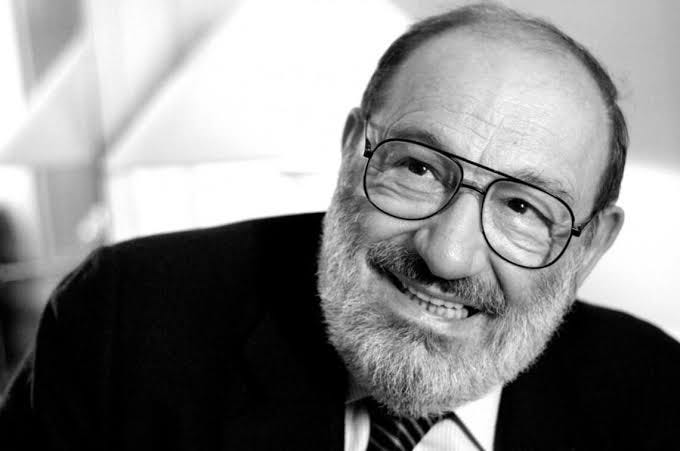
Eco ended up suffering from the worldwide success of this book. In 2011, at the Turin Book Fair, he said: “I hate this book and I hope you hate it too”, because that enormous triumph had eclipsed all the rest of his work, a lifetime of essays, the later novels, crushed for ever in the shadow of that first title. The book written for himself had become everyone’s, and at that point it had stopped being his. It is the paradox of someone who makes a thing for the pleasure of making it, and makes it so well that they end up its prisoner. But it is also the clearest proof that the book was anything but a calculation to please. It was something that had grown inside him, and that outgrew him.
I like to keep Eco in mind on the days when I feel I am late, or that I should lower my sights to be read. A professor of nearly fifty who feels like poisoning a monk, writes the book he would like to read himself, and then finds fifty million people he was not even looking for.
A thousand, he thought. About the first thousand he was right. They were him.
PS. We miss you so much, Prof.
Mantica arrives every Tuesday, in Italian. Thousands of people read it, and it’s free.
Subscribe to ManticaMore letters →Stories →